


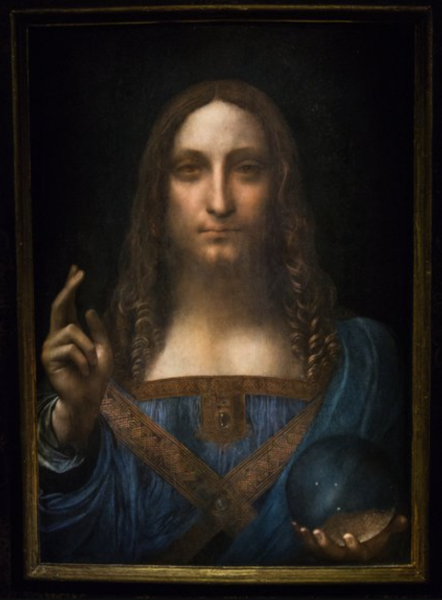
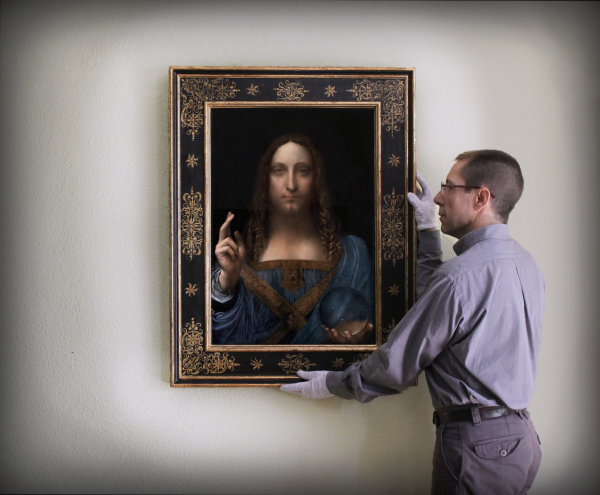
On November 15, 2017, Salvator Mundi, a depiction of Christ as ‘Savior of the World’ believed to be by renowned artist Leonardo da Vinci, became the most expensive painting ever sold. Originally costing £45 at Sotheby’s in 1958, Salvator Mundi had a quick rise to fame as one of the most mysterious and controversial works of the 21st century.
Prior to 1958, the creation and whereabouts of Salvator Mundi are merely speculation. The painting is believed to be created around 1500 for King Louis XII of France and Anne of Brittany. The painting was then inherited by the British Royal family after French Queen Henrietty married King Charles I in 1651.
The masterpiece then went missing for nearly 150 years, but in the early 19th century, it appeared in the Cook Collection. The painting was attributed to Giovanni Antonio Boltraffio, one of Leonardo’s most notorious students. At the time, the original work had been extremely painted over.
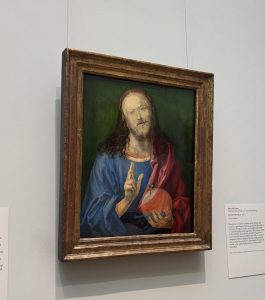
In 1958, 136 paintings were offered to Sotheby’s, and there the Salvator Mundi sold for £45. The painting’s whereabouts were left undisclosed for the next 50 years until it showed up at an regional auction in the United States where art dealers Alexander Parish and Robert B. Simon purchased it for $1,175. The dealers took interest in the painting because they believed it was undervalued and would do well on the resale market.
Simon brought the work to Dianne Modestini, senior research fellow and conservator of the Kress Program in paintings conservation at the Conservation Center of the Institute of Fine Arts, New York University two weeks after its purchase in 2005. She reviewed the painting minimally, and once Simon left, showed it to her husband, Mario Modestini. Modestini is one of the most talented restoration artists of Italian Renaissance paintings of the 20th century, and he is a connoisseur in Da Vinci’s style and era.
Only months thereafter, Mario Modestini passed away.
By 2007, Dianne Modestini had begun a comprehensive restoration of the piece. Salvator Mundi was severely damaged, with significant damage spanning the left side of the painting. One of the greatest controversies surrounding this work discusses the potential that Modestini restored the painting a bit too well.
Many factors contributed to the speculation of this painting being a potential da Vinci: the attention to detail and light on Christ’s curls, the choice to paint on walnut, and most notably the pentimenti, or alterations between the original and final draft. Christ’s blessing hand had been shifted down and to the left, an incredibly large change for a student copying da Vinci’s work, signifying that this was not a copy; it was an original.
As Modestini was working on the restoration of the upper lip one evening, Modestini struggled to seamlessly transition between lip and skin. She compared the shading of Salvator Mundi’s to that of the Mona Lisa. This similarity confirmed that this was a Leonardo da Vinci.
The painting was brought to the National Gallery in London where it was reviewed by many experts, including five Leonardo scholars, Carmen Bambach, David Alan Brown, Maria Teresa Fiorio, Martin Kemp, and Pietro Marani. It is not clear if these individuals ever came to a consensus on the authenticity of the work.
Among other reviewers was Luke Syson, an art curator who put together the 2011 Leonardo Court of Milan at the National Gallery. Salvator Mundi was displayed in the exhibit, solidifying its status as an authentic Leonardo, although there are critics who may dispute this claim.

During this, art dealers Simon and Parish are attempting to sell the painting. They connected with the Dallas Museum of Art, who seemed to be the only serious institute of interest. The painting remained unsold as it had been “burned.” The painting had been through too much controversy to be of interest to the museum.
Private collectors and Freeports were still watching from the sidelines. The painting was purchased privately in April, 2013.
It was revealed in 2016 that Russian oligarch Dimitry Rybolovlev had purchased the painting from Swiss Freeport owner, Yves Bouvier. Bouvier bought the painting for $80 million and sold it to
Rybolovlev for $127.5 million the very next day.
Rybolovlev believed that Bouvier was acting as an agent, but deals like this had been happening between the two for over a decade. Bouvier pocketed over $1 billion. When Rybolovlev realized he had been disillusioned, he sold his entire art collection.
Salvator Mundi arrived in New York City where Modestini retouched it one final time before the Christie’s auction at which it would be sold. The night of the auction, the painting was sold to a private buyer after 19 minutes of intensity for $450.3 million after fees. At the time, the buyer remained anonymous.
December, 2017, the story broke that the buyer of Salvator Mundi was Saudi Arabia’s Crown Prince Mohammed bin Salman. Originally, the Saudi Arabian government denied these claims, but then tweeted that the painting would be shown in the Louvre Abu Dhabi. The deal between the two entities was ultimately cancelled. The painting has not been seen since the Christie’s auction.
Read Dianne Modestini’s first-hand accounts with Salvator Mundi’s and the retelling of its life.


